
Master's and Bachelor's theses
at the Software Engineering Chair
Universität des Saarlandes – Informatik
Informatik Campus des Saarlandes
Campus E9 1 (CISPA)
66123 Saarbrücken
E-mail: zeller @ cs.uni-saarland.de
Telefon: +49 681 302-70970


Topics
Conducting your Bachelor, Master's or PhD thesis at the Software Engineering Chair is fun, has impact on practice, and is at the foremost frontier of research. We offer a multitude of topics in the areas of
- Software Testing
- Specification Mining
- Automatic Parallelization
- Mining Software Archives
- Automated Debugging
As we come up with new topics and ideas every week, we'd like to interact with you in person to find a topic that best suits your interests and capabilities. Just contact us and schedule an appointment with Andreas Zeller.
How to do a Thesis in Software Engineering
If you want to do a thesis at our chair, please send a letter of motivation and your most recent transcript of records to Professor Zeller.
Before the thesis starts, you have to attend the bachelor/master seminar. More information to study- and examination regulations can be found at the Examination Office of the Faculty.
Seminar
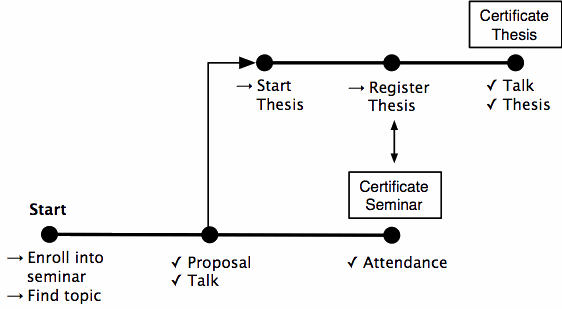
In the seminar phase, you are supposed to prepare your thesis. The seminar phase comprises the following steps:
- Topic
- The first step is to find a suitable topic and advisor. If you're unsure what's going on at the chair, you can listen to talks, approach PhD students or Prof. Zeller himself.
- Attendance
- You have to attend the seminar on a regular basis. The current rule is that in order to pass the seminar you have to visit the seminar at least 10 times.
- Preparation
- Your advisor will give you literature to read and possibly make you write a prototype or perform some preliminary experiments. This is important to help you understand your topic. This is a major part of the seminar which is mostly done in self-study.
- Proposal
- You have to write a thesis proposal that describes the goals of your thesis and the steps required to achieve those goals. See below.
- Talk
- Once the proposal is done, you have to give a talk in the seminar.
Upon successful completion of those steps, you get a certificate (Schein) for the seminar. Congratulations!
Thesis Proposal
Your proposal serves as a contract between you and our chair. It describes a well-defined task and its outcome as well as possible risks. This helps you finish your thesis in time and protects you from unexpected changes.
A thesis proposal is usually between 8 to 10 pages long and consists of the following:
- Cover page including
- thesis title
- your name
- date
- revision information, if appropriate
- names of supervisors and advisors
- A short abstract (1-2 paragraphs)
- An introduction into the field, the problem and the proposed solution (1 page max.)
- A discussion of the related work that has been conducted before. Discuss how your proposed work is related (and how it possibly advances the state of the art).
- The method you want to use to address the problem. Explicitly state verifiable hypotheses.
- The evaluation you want to use to assess how well your solution works. Provide details on how to verify the hypotheses started earlier (experiments, subjects, measures, ...)
- A schedule with verifiable milestones to be reached on a specific date. State potential risks for the proposal and their impact, as well as how to mitigate them, including alternatives.
- Explicit success criteria that will help to assess your thesis, as lists of items:
- Must-have criteria: Things your thesis must cover to be successful
- May-have criteria: Things your thesis can cover to improve its value
- Must-not-have criteria: Things your thesis will not cover (although one may think so)
- A bibliography listing all references.
Thesis
The earliest point in time when you can start working on your thesis is right after you handed in your thesis proposal and gave a talk in the seminar. As soon as you got the certificate for the seminar, you have to register your thesis in the same semester or in the semester after you got the certificate.
After you have registered your thesis you have to submit the thesis within the deadline set in the registration . For Bachelor students this will normally be three months, for master students this will be six months.Successful completion of a thesis consists of the following steps:
- Implementation
- Typically, a thesis investigates a hypothesis. Depending on the concrete topic, you'll have to implement a tool and possibly infrastructure to conduct experiments that prove or disprove the hypothesis.
- Thesis
- Once you've completed your experiments and collected the results, you can start writing the thesis.
- Talk
- You'll present the results of your thesis in a 30-minute talk in the seminar.
Once you finished the steps described above, you'll get a certificate (Schein) for the thesis. Congratulations!
The process described above is summarized in the following diagram:
Frequently Asked Questions
- Can I start my thesis during the semester? Yes, it is absolutely possible to start during the semester.
- I won't be able to work full-time on my thesis. What can I do? Your study regulations allow you to apply for a part-time thesis which doubles the amount of time available for your thesis. For a bachelor thesis, you'll have 6 months and 12 months for a master thesis.
- Can you extend the thesis deadline? Once the thesis is registered, extending the deadline is up to the Prüfungssekretariat. You can for example apply for a deadline extension if you're sick for a longer period.
- Can I continue working on my topic after completion? If you were unable to explore your topic fully and your advisor is also interested in continuing your work, it is sometimes possible to support further effort with a HiWi contract.
Impressum ● Datenschutzerklärung
<webmaster@st.cs.uni-saarland.de> · http://www.st.cs.uni-saarland.de//arbeiten/ · Stand: 2018-04-05 13:40